Cat-Friendly Cleaning Products: A Safer Routine for Cat Homes
Build a cat-friendly cleaning routine for floors, bowls, litter boxes, counters, and bedding, with label checks and precautions for paws and grooming.
Educational guidance, not a diagnosis or substitute for veterinary care. PetVitals separates editorial information from advertising and affiliate relationships.
Choose your next step
Check a product, compare the cleaning routine, or prepare a printable guide.
Quick Answer: Cat-Friendly Cleaning Products
For everyday cat-home cleaning, use a compatible mild cleaner exactly as directed, rinse washable bowls and toys thoroughly, and choose an enzymatic pet-mess product when its label covers the accident and surface. Avoid phenol-containing disinfectants. Keep cats away until all required rinsing, ventilation, drying, and pet-access conditions are met; drying alone is not proof of safety.
Cats walk across cleaned surfaces and groom their paws and fur. They may also jump onto counters, drink from an open bucket, or investigate a used wipe. A safer routine controls those exposure routes as well as the product choice.
Choose the guide for the job, rather than treating cleaning, disinfecting, and drying as the same task:
- Daily cat-home cleaning: use the floor, bowl, litter box, and bedding routine below.
- Choosing a product: compare pet-safe cleaner categories and manufacturer examples.
- Targeting germs: check disinfectants, contact time, and rinsing for cat homes.
- Letting a cat back in: use the mopped-floor return conditions.
Match the Routine to the Surface Your Cat Uses
| Area | Routine starting point | Cat-specific check |
|---|---|---|
| Floors and paw prints | A mild cleaner labeled for the finish; steam only on manufacturer-approved floors | Meet dilution and rinsing instructions. Block access while wet; steam must cool too. |
| Urine or vomit spots | An enzymatic cleaner labeled for the material and mess | Blot first and follow application directions. Do not cover the odor with perfume or mix cleaners. |
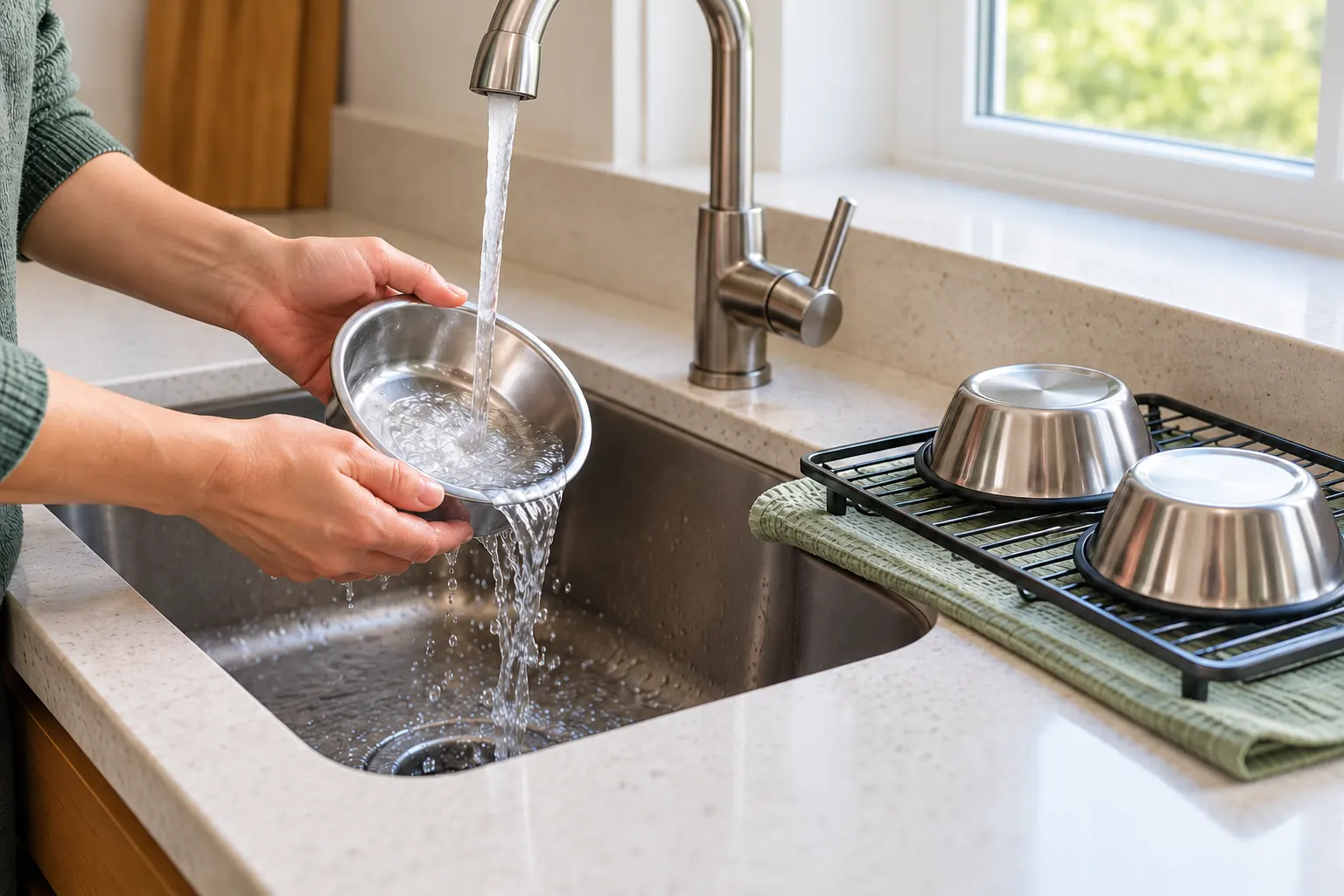
| Food and water bowls | Soap or detergent and water; dishwasher if permitted | Scrub and rinse well. A non-food-contact wipe instruction is not a bowl instruction. |
| Litter box | Wash, rinse, and use suitable disinfection directions when scheduled or needed | Keep cats away from the empty box and products until required rinsing and drying are complete. |
| Counters and windowsills | A compatible routine cleaner; a labeled disinfectant when germ control is needed | Prevent jumping onto wet surfaces and complete any food-contact rinsing instructions. |
| Bedding and blankets | Detergent and fabric-directed washing | Fragrance-free, dye-free detergent may suit sensitive skin. Store detergent pods and dryer sheets securely. |
A Practical Routine for Paws, Grooming, and Hidden Residue
- Move the cat and its essentials: use a separate room with water, resting space, and litter access. Remove bowls and toys from the cleaning area instead of spraying around them.
- Read before applying: check the exact formula, surface, dilution, required rinsing, and animal-access directions. Do not infer ingredients from a brand name.
- Remove dirt first: wipe or wash ordinary messes. If disinfection is required, follow that product's pre-cleaning and wet contact-time directions.
- Finish the label steps in order: rinse when required after contact time, ventilate, and let the surface dry. Do not mix products or wipe a disinfectant off early just to let the cat back in.
- Check every access route: consider countertops, windowsills, bedding, bowls, buckets, and discarded wipes, not just the floor. Close or remove containers and store products securely.
For return timing and accidental wet-paw contact, see can cats walk on floors after mopping. There is no universal five-, ten-, or thirty-minute waiting rule. An odor-free or dry-to-touch check cannot correct a wrong product, wrong dilution, or omitted rinse.
Ingredients That Need Extra Caution in Cat Homes
Phenols: Check the Ingredient List, Not the Brand
The CDC advises not using disinfectants that list phenol in cat homes. The name can be part of a longer chemical name, such as 2-phenylphenol. Brands sell multiple formulas; a brand name alone does not identify a phenol-containing product.
Peroxide and Quaternary Ammonium Compounds
Pet Poison Helpline describes skin, eye, and digestive injuries from peroxide exposure and corrosive injury from quaternary ammonium compounds, with cats particularly sensitive to the latter. A product containing peroxide is not automatically a lower-risk countertop cleaner, and an ingredient lookup does not establish its concentration.
Some disinfectant wipes contain quats; others have different formulas. Check the actual active ingredients and surface directions. Never use household surface wipes on a cat's paws, coat, or skin. Do not give peroxide to a cat after a cleaner exposure or to induce vomiting.
Essential Oils, Bleach, and Ammonia
Concentrated essential oils and strongly scented products are not safe simply because they are natural or the cat leaves the room briefly. Fresh residue may later reach the mouth during grooming. See essential-oil cleaners and cats.
Bleach has specific label-directed uses, but incorrect concentration or contact can injure a cat. Never mix it with ammonia, acids, vinegar, or other cleaners. Ammonia can irritate airways and is not a good routine choice for a cat accident area. Keep cats away from both the products and any fumes.
Bowls, Litter Boxes, and Bedding: How Often to Clean
The CDC recommends cleaning wet-food bowls after each use and dry-food and water bowls daily. Its example schedule also includes weekly cleaning of bedding and monthly cleaning of toys, with more frequent cleaning when dirty. Follow the item's washing or dishwasher instructions and rinse away soap.
Litter boxes contact feces and urine: the CDC recommends disinfecting them as often as comparable bathroom items. Illness, vulnerable household members, or an infection-control instruction may call for more frequent cleaning and disinfection. This is different from disinfecting every ordinary floor spill. Use the cat disinfectant guide for product, contact-time, and rinsing checks.
Wash your hands after handling litter. The CDC advises that pregnant or immunocompromised people have someone else handle litter where possible. If you must do it yourself, use disposable gloves and wash your hands afterwards.
Read a Pet-Friendly Claim Carefully
A product may be suitable for use around a pet when used as directed, without being suitable for direct application to that pet. A wipe marketed for pet areas might clean but not disinfect. "Bleach-free" does not identify the other ingredients, and "no rinse" on one product does not apply to another formula from the same brand.
The EPA Safer Choice directory can help you find reviewed cleaner formulations. It does not replace the product's directions or guarantee safety for every cat and exposure. Our cleaner comparison illustrates the difference between a routine cleaning wipe and a disinfecting wipe from one manufacturer.
We have not personally tested these products or obtained a veterinary review of this article. The guidance is an editorial synthesis of the public sources linked here, not an endorsement or a toxicity diagnosis.
Evidence Behind the Cat-Specific Precautions
The CDC pet-supply guide supports label-directed use, keeping pets away during cleaning, and avoiding phenol-containing disinfectants in cat homes. Pet Poison Helpline's cleaning-product guidance describes exposure injuries, including cats' sensitivity to quaternary ammonium compounds. We checked these public sources on October 6, 2026; the poison-control article supplies hazard guidance, not a review of current retail formulas.
Information boundary: neither source tests your exact bottle, floor finish, dilution, or cat. This guide therefore does not assign a universal drying time, rank brands by clinical safety, or approve a product solely because an ingredient is missing. Use the manufacturer-direction comparison to separate a verified instruction from an assumption. Report a changed label or unclear claim through resource feedback.
What to Do After a Cleaner Exposure
Move your cat away, prevent further contact or grooming of contaminated fur, keep the product container, and contact your veterinarian or animal poison control promptly after suspected ingestion or contact with a corrosive or unknown product. The ASPCA warns that corrosive-product effects can be delayed. Do not wait for symptoms or spend time comparing cleaning products before calling.
Do not induce vomiting, give peroxide, or use a homemade neutralizer. Breathing difficulty, collapse, seizures, eye exposure, or chemical burns need urgent veterinary attention. Tell the professional the product and concentration, when contact happened, how much may be involved, and your cat's weight and symptoms.
Poisoning symptoms can help you describe an exposure, not decide that treatment is unnecessary. Once urgent care has been arranged, emergency vet costs can help with financial planning.
Cat-Friendly Cleaning Products FAQ
What cleaning products are safe for cats?
Choose a compatible mild cleaner for ordinary dirt and a labeled enzymatic product for appropriate pet messes. Avoid phenol-containing disinfectants. Keep cats away and complete every required dilution, contact-time, rinse, ventilation, drying, and pet-access step.
What cleaners are not safe for cats?
Do not use phenol-containing disinfectants in cat homes. Concentrated essential oils, peroxide, ammonia, and quaternary ammonium compounds also require caution. Prevent licking, paw contact, and exposure to fumes; a brand name does not establish the formula.
What disinfectant is safe for cats?
No disinfectant is universally safe. Use one appropriate for the surface and target germ, keep cats away, complete wet contact time and required rinsing, ventilate, and meet every label-directed pet-access condition.
Are disinfectant wipes safe around cats?
Some can be used on permitted surfaces under their exact label directions. Keep cats away, complete wet contact time and any required rinsing, and let surfaces dry before access. Never use household disinfectant wipes on paws, fur, or skin.
Are essential-oil cleaners safe for cats?
Natural does not mean safe. Concentrated essential oils and wet residues can be risky, and moving a cat out briefly does not prevent later grooming exposure. Choose a suitable alternative and check the complete product directions.
What is the safest way to clean cat urine?
Consider an enzymatic cleaner labeled for urine and the affected surface. Blot first, follow application, rinsing, drying, and pet-access directions, and avoid ammonia or mixing cleaners. An odor-removing product is not necessarily a disinfectant.
What is the safest cleaner for a home with cats and dogs?
Choose for the surface and the needs of both species. Avoid phenol-containing disinfectants in cat areas, use products exactly as directed, and keep both cats and dogs away until all rinsing, drying, ventilation, and pet-access conditions are met.
Can I disinfect a litter box with bleach?
Use a suitable bleach product only under its exact label or veterinary directions. Clean first, follow dilution and wet contact time, never mix cleaners, rinse as directed, ventilate, and let the box dry before refilling and allowing access.
Step 1
Keep pets out
Close the room while cleaning
Step 2
Ventilate
Open windows or run exhaust fans
Step 3
Follow the label
Complete contact time and required rinsing
Step 4
Check before return
Meet pet-access directions; surfaces must be dry and cool
Cleaning Ingredient Checker
An ingredient name is not a safety guarantee. Check the exact formula and all label directions; a dry surface can still contain residue.
Phenols / pine-oil disinfectants
Higher-risk residue and fumes, especially for cats that groom paws after walking on floors.
For suspected ingestion or contact with a corrosive or unknown cleaner, contact your veterinarian or animal poison control promptly. Do not wait for symptoms or induce vomiting. Breathing difficulty, eye exposure, burns, or collapse need urgent veterinary attention.
Evidence and limits
This reference matches ingredient names to general cautions; it does not measure concentration, analyze a complete formula, or certify a product. No match is not a safety finding. Product-specific directions and veterinary exposure advice take precedence.
Exposure cautions: Pet Poison Helpline. Cat-home phenol precautions and pet-access guidance: CDC. These are public references, not a clinical review of this tool.
Sources and References
This article is based on the following publicly available sources. Content is written in our own words - we do not copy or translate original text.
Continue with PetVitals
Save a checklist, explore a related guide, or use a planning tool.
Pet-Safe Cleaning Checklist
A printable checklist for product directions, pet access, floors, litter boxes, bowls, and exposure notes.
Read Next
Hand-picked articles to continue your reading.
Disinfectants Safe for Cats: What to Use and What to Avoid
Choose disinfectants by the job and label, not a pet-safe claim. Check bleach, wipes, contact time, rinsing, and when cats can return.
Can Cats Walk on Floors After Mopping?
Let cats back only after the floor is dry and the cleaner's rinse and return rules are met. Check your mopping method and what to do after wet-paw exposure.